Here’s a detailed description of XWidget — what it is, its features, and why it’s useful:
✅ What is XWidget
XWidget is a desktop customization and widget platform for Windows that allows users to add interactive widgets (clocks, weather, system monitors, calendars, shortcuts, etc.) to the desktop. (xwidget.com)
It is designed to enhance desktop aesthetics while providing useful, real-time information.
Compatible with Windows XP, 7, 8, 10, and 11 (32-bit and 64-bit).
⚙️ Key Features
Widgets Collection
Includes built-in widgets like clocks, weather displays, calendars, CPU/RAM monitors, system info panels, battery indicators, and more.
Users can download additional widgets from the online community.
Custom Widget Creation
XWidget provides a widget editor allowing users to design and customize their own widgets using images, text, animations, and scripts.
Supports JavaScript scripting for interactive widgets.
Live Updates & Real-Time Information
Widgets can display real-time system data, network usage, weather updates, RSS feeds, and other dynamic content.
Themes & Layouts
Users can apply themes to group multiple widgets in coordinated layouts.
Widgets can be positioned anywhere on the desktop and can be resized or layered.
Lightweight & Resource Friendly
Designed to consume minimal CPU and RAM, even with multiple widgets running.
Community & Online Resources
Large online community provides free widgets, themes, and tutorials.
Users can share their creations and download others’ designs.
✅ Why It’s Useful
Provides a customizable desktop experience, letting users monitor system performance, weather, or other real-time information at a glance.
Useful for gamers, developers, and productivity enthusiasts who want live stats or shortcuts on the desktop.
Enhances desktop aesthetics with animated, interactive, or themed widgets.
Lets users create personal or themed desktops, similar to Rainmeter but with a simpler interface.
⚠️ Limitations
Mainly for visual customization and monitoring, not a system management tool.
Widgets may require occasional updates for compatibility with newer Windows versions.
Some advanced widget creation may require learning the XWidget scripting language.
Excessive use of widgets or animated themes can impact performance on older PCs.
Here’s a detailed description of XMeters — what it is, its features, and why it’s useful:
✅ What is XMeters
XMeters is a system monitoring tool for Windows that displays real-time CPU, RAM, disk, and network usage directly on your desktop or in the taskbar. (https://xm-labs.com/xmeters)
Designed to be lightweight and unobtrusive, it provides essential system stats without opening Task Manager or Resource Monitor.
Compatible with Windows 7, 8, 10, and 11 (both 32-bit and 64-bit).
⚙️ Key Features
Taskbar Integration
Displays CPU, RAM, disk, and network usage directly in the Windows taskbar, next to the system tray.
Allows quick glances at system performance while gaming, working, or browsing.
Customizable Monitoring
Users can choose which meters to display (CPU, RAM, Disk, Network).
Adjust meter color, size, and style to match Windows theme.
Optional transparency to make meters unobtrusive.
Detailed System Information
Hover over the meters for more detailed stats, like network speeds, memory usage in MB/GB, CPU core usage, and disk activity.
Lightweight & Low Resource Usage
Designed to consume minimal CPU and RAM, even while running continuously.
Suitable for gaming PCs where performance monitoring is important.
Custom Alerts (Optional)
Some versions allow visual alerts when CPU or RAM usage crosses a threshold, helping prevent overheating or slowdowns.
✅ Why It’s Useful
Provides real-time performance monitoring without needing to open heavy utilities.
Helpful for gamers, streamers, or content creators who need to keep an eye on system resources.
Great for troubleshooting slowdowns, high CPU/RAM usage, or network bottlenecks.
Lightweight and always visible, making it convenient for multitasking.
⚠️ Limitations
Primarily visual monitoring — it does not provide advanced system management tools.
Some features (like alerts or advanced customization) may require a paid version.
Works best on modern Windows versions; older versions may lack some visual customization options.
Here’s a detailed description of Xbox Accessories — the official Microsoft application for managing Xbox controllers and related devices on Windows:
✅ What is Xbox Accessories
Xbox Accessories is a free official Microsoft app for Windows 10 and Windows 11 that allows users to configure and update Xbox controllers and other compatible peripherals. (microsoft.com)
It works with Xbox wireless controllers, Elite controllers, and other Xbox-compatible devices connected via USB or Bluetooth.
Essential for gamers who want to customize controller settings and firmware.
⚙️ Key Features
Controller Firmware Updates
Keep your Xbox controllers up to date with the latest firmware.
Updates can improve performance, stability, and compatibility.
Button Remapping
Customize button assignments for your Xbox controller.
Remap triggers, bumpers, face buttons, and thumbsticks to suit your preferences.
Profile Management
Create and save multiple controller profiles.
Switch between profiles for different games or users easily.
Thumbstick & Trigger Sensitivity Adjustment
Adjust thumbstick dead zones and trigger sensitivity for better control in shooters or racing games.
Elite Controller Configuration
For Xbox Elite controllers: manage paddles, hair triggers, and button assignments.
Advanced options allow a fully personalized gaming experience.
Visual Feedback
Test controller buttons, triggers, and thumbsticks within the app.
Detects issues like stick drift or malfunctioning buttons.
✅ Why It’s Useful
Ensures your Xbox controller works optimally on PC with the latest firmware.
Lets you customize controls for specific games — useful for competitive gaming.
Helps troubleshoot controller issues like connectivity problems or drift.
Supports multiple devices with separate configurations for each.
⚠️ Limitations
Only works with Xbox-branded controllers or officially compatible devices.
Does not allow remapping or adjustments for non-Xbox controllers.
Some features (like Elite controller paddle configuration) require specific controller models.
Here’s a description of x360ce — what it is, how it works, and when/why it’s useful (and also what to watch out for).
✅ What is x360ce
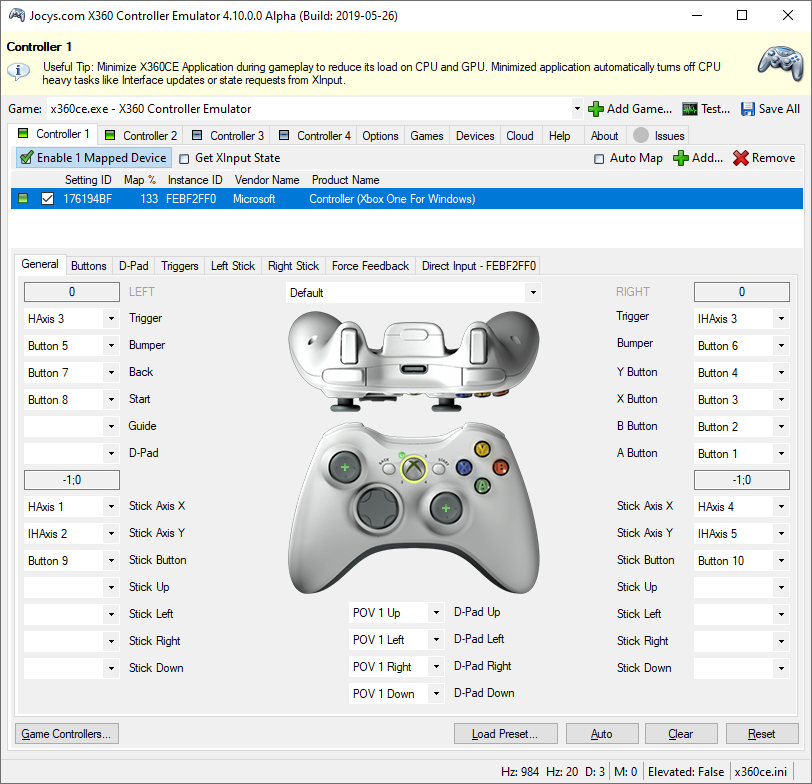
x360ce stands for “Xbox 360 Controller Emulator”. (GitHub)
Its main purpose is to let non‑XInput controllers (e.g. older DirectInput gamepads, joysticks, wheels) work in PC games that expect an Xbox‑compatible controller (i.e. XInput). (PCWorld)
Emulates an Xbox 360 controller: It intercepts input from your actual controller and “translates” it to XInput, so games detect it like a standard Xbox 360 pad. (PCWorld)
Button/Axis mapping & customization: You can manually map buttons, triggers, analog sticks, D‑pad, etc., to match the layout you prefer (or to match Xbox layout). This is helpful for controllers with non‑standard button layouts. (Appmus)
Force feedback / vibration support: If your controller supports vibration/rumble, x360ce attempts to emulate force feedback. (Appmus)
Support for variety of gamepads / joysticks / wheels: Not limited to Xbox controllers — many generic or older controllers can be “converted” using x360ce for compatibility. (PCWorld)
Per‑game configuration: Instead of a global setup, it works per game: you put x360ce files (or configure it) in the game’s directory so that mapping applies only to that game — helpful if you have different controllers or control schemes for different games. (Appmus)
Virtual controller mode (modern versions): Recent versions (4.x) use a virtual controller driver (via a virtual gamepad emulation bus) so that the system/game sees a proper “Xbox 360‑style” controller rather than just a wrapper. (X360ce)
👍 Why It’s Useful (Especially for PC Gamers)
Given that you seem to be into PC games and possibly use different kinds of controllers / setups — x360ce can be especially handy because:
It makes many otherwise unsupported controllers usable — helpful if you have a generic gamepad, joystick, racing wheel, or old controller that modern PC games don’t natively support.
Flexibility & customization — you can tailor button mappings per game (e.g. set up special controls for racing games vs shooters), which can improve your gaming experience beyond default controller configs.
Legacy support — for older games that were designed before widespread XInput adoption, x360ce helps bridge the gap and avoid forcing you to buy a new controller.
Free and lightweight — no cost, no bloat; works even on modest PCs (assuming proper drivers and config).
Useful for modders or multi‑controller setups — sometimes players use multiple controllers (wheel + joystick, or several gamepads), and x360ce’s virtual‑controller + mapping features help manage those setups.
⚠️ Limitations & Things to Know / Watch Out For
Needs manual setup per game — unlike plug‑and‑play; you often must copy x360ce files to the game folder, run calibration/mapping, and save configuration. (Ngemu)
Sometimes tricky with modern games / anti‑cheat / input detection — some games (especially newer ones) may not cooperate well with controller wrappers or virtual drivers. (X360ce)
Force feedback / vibration may not always work reliably, depending on controller or game. (Appmus)
Compatibility issues for some controllers — especially if they’re non‑standard, wireless, or have unusual input handling; mapping may require trial‑and‑error.
You might need to toggle DLL or driver mode depending on game version / architecture (32‑bit vs 64‑bit). (Ngemu)
Because it’s third‑party & emulation-based, there’s always a small risk of instability — though the project is open‑source and fairly maintained. (GitHub)
🧑💻 When / Who Should Use x360ce (Probably You)
Given your background (PC gaming, possibly older / modded games), x360ce likely fits you well if:
You have a generic or older controller / joystick / wheel not natively supported by many modern PC games.
You like to customize controls, or have special control schemes for different games.
You play older games or indie games that don’t support newer controller APIs (XInput).
You don’t mind a bit of configuration/setup — you accept per‑game tweaks in exchange for broader compatibility and flexibility.
Here’s a description of Wise JetSearch — what it is, how it works, and when/why you might want to use it.
✅ What is Wise JetSearch
Wise JetSearch is a free file‑search utility for Windows, developed by WiseCleaner. (WiseCleaner)
It aims to be a fast and simple alternative to the default Windows file‑search, letting you quickly find files and folders on local and removable drives. (WiseCleaner)
It works on a wide variety of Windows versions (Windows XP all the way to Windows 11), both 32‑ and 64‑bit. (WiseCleaner)
⚙️ How Wise JetSearch Works — Key Features
Fast search using its own indexing — Wise JetSearch can scan and index up to ~1,000,000 items (files/folders) and return results in milliseconds, which tends to be much faster than the built-in Windows search. (WiseCleaner)
Supports many drive types — It works on different file system types including NTFS, FAT, and exFAT; so you can search on internal hard‑drives, SSDs, external drives, USB sticks, etc. (WiseCleaner)
Wildcard & flexible search — If you don’t remember the full file name, you can use wildcards (*, ?) to match parts of names, or search by extension (e.g. *.png) or patterns. (WiseCleaner)
Preview pane & quick operations — After finding items, you can preview them (for supported types), open their containing folder, copy paths, or delete files directly via right‑click menu. (WiseCleaner)
Portable (optional) version available — There is a portable build so you can run Wise JetSearch without installing it (good for USB / external drives). (Portable Apps)
Low resource usage — The program is lightweight (only a few MB) and designed to use minimal system resources, making it suitable even on modest PCs. (WiseCleaner)
👍 Why It’s Useful — Strengths & Pros
Much faster than default search: If you have many files (games, documents, media) and often need to locate something quickly — Wise JetSearch can save a lot of time.
Works on multiple drive types (internal, external, USB) — Helpful if you manage files across several disks/formats.
Simple UI and easy to use — Useful if you want a no‑fuss, straightforward tool without complicated settings.
Portable option — Good if you want to carry it on a USB stick and use on different PCs without installation.
Good for large libraries — If you have many folders (games, mods, media), the quick search helps especially in those cases.
⚠️ Limitations & What to Be Aware Of
Wise JetSearch appears to search by file/folder name, not by content — so you can’t search inside documents/text for words; only file names and extensions. (AlternativeTo)
As some users note, for full‑text search (inside files, e.g. searching text in .txt, .docx, etc.) you might need more advanced tools. (AlternativeTo)
If you have very large drives, initial indexing or scanning might take some short time (though far less than Windows default search in many cases).
🎯 Who Is It Good For — When to Use Wise JetSearch (Especially for You)
Since you use a PC for gaming, files, maybe mods and lots of data, Wise JetSearch could be very handy for you:
If you frequently download or move files (games, saves, mods, media) and later struggle to find them — JetSearch can locate them quickly.
If you often use external drives or USBs and want a fast search across them.
If you want a lightweight, no‑installation tool to carry on a USB flash drive — useful when moving between PCs or reinstalling OS.
If you prefer a clean, simple search tool without overhead or complex indexing setups required by modern “search everything” solutions.
Here’s a breakdown of Wise Auto Shutdown — what it is, how it works, and when/why you might want to use it (or avoid it).
✅ What is Wise Auto Shutdown
Wise Auto Shutdown is a small Windows utility whose main purpose is to let you automatically schedule power‑actions (shutdown, restart, sleep, hibernate, log‑off, lock screen) for your PC. (WiseCleaner)
It is free (freeware) and lightweight. (Softpedia)
It supports a wide range of Windows versions — from older ones (Windows XP, Vista) up to the latest (Windows 10 / 11), both 32‑bit and 64‑bit. (WiseCleaner)
⚙️ What It Can Do — Key Functions & Scheduling Options
Wise Auto Shutdown offers a variety of power‑management options and scheduling modes: (WiseCleaner)
Run the action at a specific time/date (e.g. shut down at 23:00). (WiseCleaner)
Run after a countdown (e.g. 2 hours from now) — useful if you leave a download or process and want PC to turn off later. (ALLPCWorld)
Recurring schedules (daily / repeated) or one‑time execution. (WiseCleaner)
Reminders / notifications — Program can notify you some minutes before the scheduled action executes, giving you a chance to postpone or cancel if needed. (WiseCleaner)
Background / silent mode — Once schedule is set, it minimizes to system tray and doesn’t disturb your workflow, running quietly until it’s time for the action. (WiseCleaner)
One‑click manual control — Right‑clicking the system tray icon lets you immediately shut down or restart, even without schedule. (WiseCleaner)
Because of these, you can use Wise Auto Shutdown for scenarios like:
Ensuring PC shuts down overnight when downloads or updates finish.
Automatically putting PC to sleep or hibernate when idle.
Scheduling restarts or logoffs at set times (helpful if you keep important tasks running at certain hours).
Saving energy — convenient if you forget to turn off PC when done.
👍 Why It’s Useful — Pros
Very simple and easy to use: intuitive interface; few clicks to schedule tasks. (WiseCleaner)
Flexible scheduling — multiple modes (time, countdown, recurring) — caters to different needs (downloads, sleep timers, regular shutdowns…) (ALLPCWorld)
Free and widely compatible — works on most Windows versions (old and new). (WiseCleaner)
For someone like you (using PC for gaming, file downloads, mods, tasks) — it can be especially handy to avoid leaving the PC on overnight, save power, or automatically shut down after heavy downloads/gaming sessions.
⚠️ Limitations / What to Watch Out For
Since it automates shutdown/restart/etc., there’s always a risk of losing unsaved work if schedule triggers while you forgot to save — so you need to be careful.
If you rely on background tasks (downloads, updates, rendering, etc.), automatic shutdown may interrupt them — so you need to plan schedule carefully.
It’s a simple tool: it doesn’t detect activity — meaning if PC is idle or active, the scheduled action will run anyway (unless you postpone).
Some power actions like “Sleep” or “Hibernate” depend on hardware and Windows settings — so behavior may vary depending on your PC.
🧑💻 When/Why You Should Use Wise Auto Shutdown (Given Your Background)
Good for setting automatic shutdown or sleep after late‑night downloads or installs, especially if you often leave the PC running overnight.
Handy if you often forget to turn off your PC after using — “set it and forget it.”
Useful for managing PC power and energy consumption, especially if you want to avoid leaving the PC on when not actively using it.
Nice simple tool for someone who doesn’t want to rely on built‑in OS timers or scripts — needed minimal setup, easy to use.
Here is a clear and concise description of Tiny11:
Tiny11 – Application Description
Tiny11 is a lightweight, optimized version of Windows 11 designed to run on older or low-spec hardware. By removing unnecessary components and features, Tiny11 reduces system resource usage while retaining the core functionality of Windows 11, making it faster and more efficient.
It is ideal for users who want the look and feel of Windows 11 on machines that cannot run the standard version smoothly. Tiny11 is often used for older PCs, virtual machines, or specialized use cases where performance and low resource usage are essential.
Key features include:
Lightweight and resource-optimized version of Windows 11
Reduced system requirements for older or low-spec PCs
Maintains core Windows 11 functionality and interface
Faster performance and smaller footprint
Suitable for virtual machines or legacy hardware
Tiny11 is ideal for users who want a modern Windows 11 experience on less powerful hardware.
Here’s a detailed explanation of Winstep Xtreme — what it is, what it offers, and when/why you might want to use it.
✅ What is Winstep Xtreme
Winstep Xtreme is a desktop‑enhancement / customization suite for Windows — a collection of tools that let you drastically change how Windows desktop looks and behaves. (Winstep)
It’s meant to run on top of Windows (not replace Windows), providing docks, shelves, custom menus, widgets, and more to help you organize, customize, and beautify your workspace.
The software supports Windows 7, 8, 10, and 11 (both 32‑bit and 64‑bit). (Winstep)
🛠️ Core Components and Features
Winstep Xtreme isn’t just a single feature — it bundles several sub‑tools, each serving a different purpose. (Winstep) Here are the main ones:
Nexus Ultimate: a dock‑system, similar to macOS‑style docks, which gives you quick access to your favorite apps, folders, and shortcuts. You can have multiple docks, sub‑docks, and stacked docks (grid stacks) for organization. (Winstep)
WorkShelf: a “tabbed dock” tool — lets you create shelves/drawers that can hold apps, files, folders, or links. Helps a lot if you want a clean desktop with no clutter, while still having quick access to everything. (Winstep)
NextSTART: replaces (or works alongside) the Windows Start menu/taskbar — offering customizable menus, better task‑/window‑management, and flexible hotkeys for launching apps or performing actions. (Winstep)
Widgets / Modules / Docklets: small tools you can place on the desktop, docks or shelves — e.g. clock (digital or analog), weather, system monitors (CPU/RAM/Network), battery monitor, calendar/reminders, email checker, and other handy widgets. (Winstep)
Full Visual & UI Customization: Skinnable docks/menus/widgets, icon reflections & animations, blur/transparent effects, customizable themes — letting you make Windows look very different and stylized. (WinCustomize)
Desktop Organization & Cleanliness: Shelves and docks let you hide desktop icons while still accessing them easily, reducing clutter and giving a cleaner, minimalist look. (Winstep)
Multi‑monitor & High‑DPI Support: Works properly across multiple monitors and with high‑DPI settings (important if you have newer displays). (Winstep)
Additionally, it supports customizing many aspects: drag‑and‑drop management, custom hotkeys/hotspots, configurable context menus, internal commands (shutdown, open folder, system commands, etc.), and more. (Winstep)
✅ Why People Use Winstep Xtreme — Benefits
Improved productivity & organization: Quick access to frequently used apps/folders, less time searching menus or wandering through file explorer.
Desktop cleanliness & minimalism: You can hide desktop clutter (icons) while still having easy access via shelves or drawers.
Visual appeal: If you like customizing and making your desktop look unique — themes, animations, widgets — Xtreme gives flexibility to do that.
Flexibility & customization: Unlike the default Windows UI, Xtreme lets you tailor the desktop environment to your workflow and tastes.
Convenience features: Widgets for system monitoring, weather, clock, reminders — useful for daily use, especially if you multitask or manage many things at once.
For someone like you — who uses a PC for games and general tasks — Xtreme can help make the desktop more organized and visually enjoyable, maybe even turn it into a “launchpad” for your games, mods, and tools.
⚠️ What to Be Aware Of / Possible Downsides
Because of the visual effects, docks, widgets, and animations — it uses more system resources than vanilla Windows UI. On older PCs, performance may be impacted. (SaaSHub)
Some features (especially deep customization) may have a learning curve — initial setup might take time if you want a polished look and feel.
In some cases, compatibility issues may arise (especially with video players or applications using special rendering modes) — e.g. issues reported with certain media players when Xtreme is active. (Winstep)
It’s a third‑party suite — so you must download it from official source and ensure any addons/themes are safe.
🎯 Who It’s For — When Winstep Xtreme Makes Sense
Winstep Xtreme is ideal for:
Users who value desktop customization — want Windows to look personalized, modern, or stylish.
People who run many applications/folders/tools and want quick access — gamers with many games, modders, or power users.
Those who prefer organization and a clean desktop rather than cluttered shortcuts.
Anyone wanting widget tools (system monitor, weather, clock, reminders) on desktop for convenience.
Users with a reasonably capable PC, so that extra visual effects don’t cause slowdown.
Here’s a detailed description of Winstep Nexus Dock — what it is, its features, and why users install it:
✅ What is Winstep Nexus Dock
Winstep Nexus Dock is a desktop enhancement application for Windows that provides a customizable application dock, similar to the dock in macOS. (winstep.com)
Designed to help users launch apps, access shortcuts, and organize their desktop more efficiently.
Compatible with Windows 7, 8, 10, and 11.
⚙️ Key Features
Customizable Dock
Create multiple docks on the desktop.
Add shortcuts for applications, folders, and files.
Supports icons of any size and custom icon sets.
Visual Effects & Animations
Supports smooth zoom effects when hovering over icons.
Can apply shadows, reflections, and transparency.
Provides live icon indicators for certain apps (e.g., running tasks).
Docklets & Widgets
Small tools that display useful information: clock, CPU usage, weather, calendar, and more.
Extend functionality beyond simple shortcuts.
Auto-Hide & Smart Positioning
Dock can auto-hide when not in use to save screen space.
Can be positioned on any edge of the screen.
Themes & Skins
Supports multiple skins and themes for visual customization.
Users can import or create their own themes.
Keyboard Shortcuts & Hotkeys
Quickly open apps or docklets using custom hotkeys.
Streamlines workflow for power users.
✅ Why It’s Useful
Provides a clean, organized, and visually appealing interface for launching applications.
Improves desktop productivity by giving quick access to frequently used apps and folders.
Popular with users who like customization and aesthetics, making Windows feel more modern and personalized.
⚠️ Limitations
Extra system resources: Can slightly affect performance on older PCs.
Some features require paid Pro version; free version has limited customization.
Not a necessity for basic users — mainly a visual and productivity enhancement.
Here’s a detailed description of Windows Subsystem for Linux (WSL) — what it is, how it works, and why it’s useful:
✅ What is Windows Subsystem for Linux (WSL)
Windows Subsystem for Linux (WSL) is a Microsoft feature that allows you to run Linux distributions natively on Windows 10 and Windows 11 without using a traditional virtual machine. (microsoft.com)
First introduced in 2016, it has evolved through WSL 1 and WSL 2.
WSL is designed for developers, IT professionals, and power users who need Linux tools alongside Windows.
⚙️ Key Features
Run Linux Natively on Windows
Run Linux command-line tools, utilities, and apps directly on Windows.
Compatible distributions include Ubuntu, Debian, Fedora, Kali Linux, openSUSE, and more.
Two Versions: WSL 1 and WSL 2
WSL 1: Translates Linux system calls to Windows calls — lightweight, fast for many tasks, but limited in full kernel support.
WSL 2: Uses a lightweight Hyper-V virtual machine with a full Linux kernel, offering full system call compatibility, better performance, and support for Docker containers.
Integration with Windows
Access Windows files from Linux and Linux files from Windows seamlessly.
Use Linux tools like grep, sed, and awk alongside Windows applications.
Run GUI Linux apps on Windows 11 via WSLg (WSL GUI).
Networking & Development Tools
Support for Docker Desktop and containerized workflows.
Ability to run web servers, databases, and other Linux-based services locally.
Integrates with Visual Studio Code for seamless development with Linux tooling.
Performance & Efficiency
Minimal overhead compared to traditional virtual machines.
Supports GPU acceleration for AI/ML workloads (in WSL 2 with compatible hardware).
✅ Why It’s Useful
Developers: Build, test, and deploy Linux applications on Windows without dual-booting.
Sysadmins: Manage Linux servers using native command-line tools.
Students and Learners: Practice Linux commands, scripting, and software development on a Windows PC.
Gaming & AI: Run Linux tools for AI/ML development with GPU acceleration without leaving Windows.
⚠️ Limitations
Some low-level Linux apps may require WSL 2 for full compatibility.
Requires Windows 10 (2004+) or Windows 11.
Not intended for full-scale Linux desktop replacement (though GUI apps are supported).
GPU acceleration and advanced networking features need compatible hardware and drivers.
Here’s a breakdown of Windows 11 Installation Assistant — what it is, how it works, and when (and when not) you might want to use it.
✅ What is Windows 11 Installation Assistant
Windows 11 Installation Assistant is an official tool from Microsoft that helps you upgrade an existing Windows 10 PC to Windows 11 in a simplified, guided way. (Microsoft Support)
It’s designed for users whose PC meets the hardware/firmware requirements for Windows 11; it performs compatibility checks and — if everything matches — will download and install Windows 11 for you. (Microsoft Support)
⚙️ How It Works — Steps & Behavior
When you run Installation Assistant:
The tool first checks whether your PC meets the requirements (CPU, RAM, storage, TPM/UEFI, etc.). If not — it informs you and stops. (Microsoft Support)
If your PC is compatible, you click “Accept and Install”, and the tool will:
Download the needed Windows 11 files from Microsoft’s servers. (MakeUseOf)
Begin the upgrade process automatically, carrying over your files and most settings/apps from Windows 10. (MakeUseOf)
Restart the PC one or more times to finalize the installation. (Microsoft Support)
Because it downloads directly and does the installation in‑place, you do not need a USB drive, ISO file, or manual media creation — everything is handled by the tool. (Geeky Buddy)
✅ Pros — Why Use It
Simplicity: Very easy for typical users — just run it and follow prompts. No need to deal with USB, ISOs, or manual setup.
Official and up‑to‑date: Since it’s from Microsoft, you get genuine, latest Windows 11 build with appropriate updates and support.
Keeping your data & apps: Designed to upgrade from Windows 10 while retaining your files, apps, and most settings (not a full clean install). (MakeUseOf)
Automatic compatibility checking: It will warn you and stop if your PC isn’t compatible — avoiding wasted time or failed installs.
⚠️ Cons / Things to Watch Out For
Only works if PC meets requirements: If your PC lacks TPM 2.0, UEFI, enough RAM/space, or has incompatible CPU/firmware — it will refuse. (Microsoft Support)
May take a while: Download + install + restarts can take hours — so you need to be sure you can spare the time and that PC stays powered and connected to internet. (MakeUseOf)
Not a “fresh install” option: This tool upgrades your existing system. If you need a clean install (wipe + fresh system), you’ll need other tools (e.g. media creation / ISO / USB).
Sometimes upgrade hangs or stalls: There are user reports that in rare cases the install may get stuck (e.g. around 99 %) or fail — which may require troubleshooting or a different installation method. (Microsoft Q&A)
🎯 When You Should Use It (or Skip It)
Good idea to use if:
You have a Windows 10 PC that meets Windows 11 requirements, and you want a quick, easy upgrade without losing data.
You don’t want to manually deal with bootable media or more complicated installation processes.
You prefer staying on officially supported, up‑to‑date, and secure OS (especially now that support for Windows 10 ended).
You might skip it / consider alternatives if:
Your PC doesn’t meet requirements (TPM, UEFI, disk space, etc.).
You want a clean install (fresh OS, no old garbage) — in that case, using an ISO + USB (or official media tool) is better.
You experienced issues with the installer (it hangs, fails, or you had compatibility warnings).
Here’s an overview of Windows 11 — what it is, what it offers, what it requires, and what to consider in 2025 (especially if you think about upgrading from older Windows versions).
✅ What is Windows 11
Windows 11 is the current major desktop operating system from Microsoft — successor to Windows 10. (Microsoft Support)
It was first released to the public in October 2021, and is intended to be Microsoft’s main supported Windows edition going forward. (Microsoft Support)
Windows 11 aims to provide a more modern user interface, improved security, updated features, and better support for newer hardware and technologies. (Microsoft Learn)
⚙️ Key Features & What’s New (vs older Windows)
Windows 11 brings a number of improvements and changes compared to older versions:
Modernized interface and usability changes — refreshed design, improves user experience, and integrates well with modern workflows and hardware. (Microsoft)
Support for modern hardware & gaming technologies:
Capabilities like DirectStorage (for faster game loading) and DirectX 12 Ultimate — provided compatible SSD and GPU — which benefit gamers and heavy‑duty applications. (Microsoft)
Better security features, management of updates, compatibility with newer chips, firmware security standards, etc. (Microsoft)
Ongoing Support & Updates — Windows 11 receives regular monthly security updates, and feature updates periodically, which helps keep the system secure, stable, and current. (Microsoft Learn)
Better compatibility for modern workflows — newer versions of applications, drivers, and tools tend to target Windows 11 (or at least ensure full support on it), which helps ensure long-term compatibility.
📦 System Requirements for Windows 11 (Minimum & What to Check)
For a PC to run Windows 11 properly, it must meet certain hardware/firmware requirements. (Microsoft)
Security module: TPM (Trusted Platform Module) version 2.0 is required (or firmware-based equivalent). (TECHCOMMUNITY.MICROSOFT.COM)
Notes on extra features:
Some of Windows 11’s advanced features (e.g. High‑end gaming, virtualization, certain “Copilot+ PC” experiences, 5G support, Auto HDR, etc.) may have additional requirements, like compatible hardware (NVMe SSD, supported GPU, USB drive for BitLocker, etc.). (Microsoft)
If your PC fails to meet the required criteria and you force‑install Windows 11, you might run into stability, compatibility, or security support issues. (Microsoft Support)
🎯 Who Should Use Windows 11 — Pros & Use Cases
Given your background (you use PC for gaming and general tasks), Windows 11 is particularly well‑suited if you want:
A modern, secure, and supported OS — especially now that older OS versions are no longer receiving updates from Microsoft, staying on Windows 11 helps you avoid security risks.
Better performance and future‑proofing — for newer games, software, and hardware (SSD, modern GPUs), Windows 11 tends to provide better support and optimizations.
Long‑term compatibility and updates — since many developers are optimizing for Windows 11 (or even dropping support for older versions), using 11 ensures you get updates, support, and new features.
Peace of mind regarding security and features — as Windows 11 continues to receive monthly security patches and feature updates. (Microsoft Learn)
⚠️ What to Consider / Possible Downsides
Because Windows 11 has stricter hardware requirements, older PCs may not qualify. If your machine lacks TPM 2.0, UEFI, enough RAM/storage, or a compatible CPU/GPU — upgrade may not be possible without hardware changes. (TECHCOMMUNITY.MICROSOFT.COM)
Some advanced features or future “Copilot+ PC” experiences may require more powerful hardware — meaning a minimal install might run, but you won’t get the full benefit. (Microsoft)
If you rely on very old software, hardware, or custom setups — compatibility could be an issue (though many older apps still run under Windows 11).
Upgrading requires backup, and in some cases you might need to check for driver/hardware compatibility (especially if PC is several years old).
🔁 Upgrading to Windows 11 — What You Should Know
If you’re on an older Windows version (e.g. Windows 10), upgrading to Windows 11 is free, as long as your PC satisfies the minimum requirements. (Microsoft Support)
Before upgrading, it’s recommended to back up your important files (in case anything goes wrong during the upgrade). (Microsoft)
After upgrade, you get ongoing support, future feature updates, and access to the latest security patches and functionality. (Microsoft Learn)
✅ My Take: Should You Use Windows 11 (Given Your Background)
Since you use a PC for gaming, possibly run various applications (games, mods, tools), and value a stable system:
Yes — Windows 11 is a strong choice if your hardware meets requirements. It’s more future‑proof, receives updates, and supports modern gaming features.
Check your hardware first: make sure CPU, RAM, storage, firmware (UEFI/TPM) and GPU are compatible. Upgrading an old PC may not be worth the trouble unless you plan to buy new hardware.
Back up important data before upgrading — especially if you have custom setups, mods, or non‑standard software.
Designed to run on desktops, laptops, tablets, and hybrid devices — it is a general‑purpose OS that supports a wide range of hardware, software, and user needs. (Wikipedia)
🔧 Key Features — What Windows 10 Brings
Windows 10 introduced many improvements over earlier Windows versions: (Digital Unite)
Updated Start Menu and interface: A more modern and flexible Start menu (combining traditional menu and live tiles), a taskbar, and a redesigned look that works well with both mouse/keyboard and touch/tablets. (Digital Unite)
Multitasking and virtual desktops: Ability to create multiple virtual desktops (workspaces) and switch between them, which helps organize windows and tasks efficiently. (Wikipedia)
Improved system for apps and data: It supports “universal apps,” allowing apps to run across different types of devices (desktop, tablet, etc.) with a shared codebase. (Wikipedia)
Modern browser & web standards: Originally shipped with a new browser, Microsoft Edge (later the Chromium‑based Edge) instead of the older Internet Explorer — more secure and faster. (Wikipedia)
Security and system support: Built-in support for modern hardware standards (graphics with DirectX, drivers, better security models, compatibility with new apps) — making it a flexible and relatively future‑proof environment for both everyday use and gaming. (Microsoft)
Flexible editions — Windows 10 comes in different editions depending on your needs: Home (for regular users), Pro (for power users / small business), plus Enterprise / Education for business/organization environments. (Wikipedia)
📦 System Requirements & Compatibility
According to official specifications for Windows 10: (Microsoft)
Minimum (bare minimum)
Recommended for good use
CPU: 1 GHz or faster (or SoC)
—
RAM: 1 GB (32‑bit) or 2 GB (64‑bit)
For comfortable use, more RAM recommended (4 GB or more)
Disk space: 16 GB (32‑bit) or 32 GB (64‑bit)
—
Graphics: Compatible with DirectX 9 (or newer) + WDDM driver
For games / heavier apps: modern GPU & drivers
These are minimal — for a smooth experience (especially for games or heavy tasks), better hardware is recommended. (Microsoft)
⚠️ What’s Changed in 2025 — End of Support
Important recent development: Microsoft ended mainstream support for Windows 10 on October 14, 2025. (Windows Central)
After this date, Windows 10 will no longer receive regular security updates, feature updates, or technical support (for the standard Home/Pro/Education/Enterprise editions). (Windows Central)
That means continuing to use Windows 10 becomes riskier over time — new security vulnerabilities will not be patched, and third‑party software (apps, games) may increasingly drop support for Windows 10. (WIRED)
Users who want to maintain security may need to upgrade to Windows 11 (if hardware supports it), or consider other alternatives (e.g. switching to a different OS). (Tom’s Guide)
🎯 Is Windows 10 Still Worth Using — For Someone Like You
Given that you use PC for gaming and general tasks:
Pros:
Windows 10 remains familiar, flexible, lightweight compared with some newer OS — good for older PCs or for users who like simplicity.
It supports a vast library of software and games (especially older ones) — great for PC games, modding, retro software, etc.
If hardware is limited (older PC), Windows 10 may run more smoothly than heavier OS.
Cons (in 2025):
No new security or feature updates — over time, increased risk of vulnerabilities and compatibility issues.
New games or software may start requiring newer OS version (Windows 11 or future).
If you value long‑term security / support / modern features (especially for internet, gaming, updates), it’s safer to plan upgrading (OS or PC).